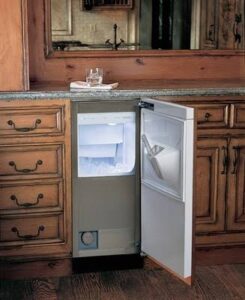
A damp spot behind your fridge or a frozen layer in your freezer sets off alarm bells. A full-blown puddle when you open the door is even worse.
Your question is simple: “why is my refrigerator leaking?” The answer is a little more complex, because it depends on where the leak is coming from.
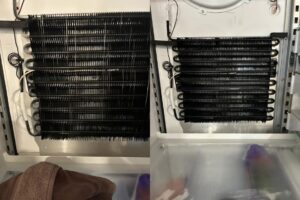
Most refrigerator water leaks are caused by one of five issues:
- A clogged defrost drain
- A damaged rubber door seal
- A malfunctioning ice maker
- A damaged drain pan
- A leak in a valve or the water supply line
When you see signs of a refrigerator leak, check for these 5 warning signs. You’ll identify the cause, identify exactly who to call to fix the leak, and potentially save yourself some money.
Why We Teamed Up With Plumbers For This Article
Some refrigerator leaks happen in the internal components or the inlet valve on the back of the unit. These are appliance repair issues you should call us about. If the leak’s in your plastic water hose or the plumbing that leads to it, a licensed plumber needs to fix it.
We talked to Steven Smith, Responsible Master Plumber at Mother Modern Plumbing. Steven has over two decades of experience with water leak repairs in the Dallas-Fort Worth Metroplex. He provided valuable insight into why leaks happen in the plumbing connected to your fridge.
Step 1: Is It Really Leaking, or Just Condensation?
Before you pay for a diagnostic service call, let’s make sure you actually have a water leak in your refrigerator- and not just extra condensation.
It’s easy to confuse visible condensation with an emergency water leak. And it’s a reasonable mistake. The moment you spot water where it shouldn’t be, the natural response is panic. It’s much easier to think “something’s broken and leaking”, instead of “it might just be humidity”.
It doesn’t help that condensation and real leaks show up in the same places- under crisper drawers, along the door gasket, pooling at the base of the fridge. That’s because both happen wherever cold surfaces meet humid air. Without tracing the water back to its source, you can’t tell them apart just by looking.
There are two easy ways to tell refrigerator condensation and a water leak apart:
- Wipe it dry and see what happens. If scattered droplets reappear, it’s a condensation issue. If you see a steady stream, there’s a water leak.
- Find the source. Condensation forms when cold air meets humid air. If you can trace the water back to one source- a hose, valve or component- it’s a leak.
5 Refrigerator Leak Warning Signs: Match the Symptom to the Cause
If you suspect there’s a water leak in or near your refrigerator, let’s match the warning signs you notice to the most likely cause.
Here are 5 frequent symptoms of refrigerator water leaks, and the locations most likely to cause them:
- Water pooling under the fridge → clogged defrost drain, damaged pan, or bad leveling
- Puddle only when you open the door → worn door gasket
- Water leaking from the back or near the wall → water line, valve, or installation issue (this is a plumber’s job)
- Ice maker overflowing or leaking inside the fridge → faulty fill valve or filter housing
- Damp wall, warped floor, or a leak you can’t trace → hidden in-wall plumbing leak
Water Pooling Under the Refrigerator
You notice a pool of water underneath your refrigerator. This puddle usually pokes out from the front of the unit, but sometimes spreads to the sides.
In most cases, this points to one of three things: a clogged defrost drain, a cracked or misaligned drain pan, or a refrigerator that isn’t sitting level. Here’s how to tell which one you’re dealing with.
Clogged or Frozen Defrost Drain
When your fridge’s defrost cycle runs, it melts frost off the evaporator coils. That water drains through a small tube into a pan underneath where it evaporates.
When food debris or ice clogs that little tube, water backs up until it drips out onto the floor.
Look for the drain hole inside your freezer at the back. If it’s iced over or blocked, try a warm water flush. If that doesn’t work, call an appliance repair specialist.
Damaged or Misaligned Drain Pan
Your drain pan is the pan underneath the fridge that catches defrost cycle water. When it’s cracked, warped or jarred loose, it can’t hold the water properly. It drips on the floor instead.
Carefully pull the pan out from under the unit and look for cracks or warping. Replacing a damaged pan is cheap, but you need the exact pan that matches your model.
Your Refrigerator Isn’t Level
Set a level on top of your refrigerator two ways: front-to-back, and side-to-side. If it’s a few degrees off, your defrost water will not drain properly.
Pooled water towards one side of the fridge is a telltale sign of a tilted unit. A few turns of the adjustable front legs often fixes the tilt with no extra parts.
If this doesn’t work, or if you’re uncomfortable moving the fridge, give us a call.
Puddle Only Appears When You Open the Door
You sopped up the original puddle near your fridge, and it didn’t return until you opened up the refrigerator door or freezer door again.
This leak issue is all about a faulty door seal- your fridge isn’t closing properly.
Worn Door Gasket Letting In Humid Air
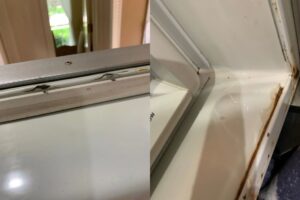
Your refrigerator door seal is a rubber gasket. This gasket keeps cold air in and warm air out. Once it cracks or stops sealing tight, warm air gets pulled in every time the door opens.
The humidity from that warm air condenses on cold interior surfaces, then drips out when you open the door.
Run your hand along the gasket and check for cracked, dried-out spots. Then, try closing the refrigerator door on a dollar bill. If the bill slides out easily, the seal is gone.
Water Leaking From the Back of the Fridge or Near the Wall
Water behind the fridge is a unique threat- it’s dark back there, and mechanical components warm the area. Damp, humid conditions cause faster mold growth and attract pests.
Here are 3 potential causes of these leaks, and when you need a plumber vs. an appliance repair service.
Cracked Water Supply Line or Hose: Call a Plumber
Most refrigerators have a plastic supply hose that carries water from the shutoff valve on your wall to your ice maker and dispenser. When that line cracks, kinks or blows a leak, it doesn’t stop spraying water until it’s fixed.
“A leaky refrigerator hose keeps leaking, even if you turn off the fridge,” says Mother’s Responsible Master Plumber Steven Smith. “If you can find the shutoff valve and turn it off, do that right away. It can save you a ton in water damage costs.”
Call a licensed plumber to replace the water supply line to your fridge. If improperly applied, DIY patch and splice kits can void your appliance warranty.
Loose or Failing Inlet Valve
The inlet valve is where the water line connects to the fridge itself. A worn-out valve or loose fitting lets water seep behind your fridge at that connection.
Check for a layer of mineral scale where the line meets the fridge- it will look crusted over. That’s a telltale sign of local hard water damage to the inlet valve.
Brand New Fridge? Check the Installation
A leak that starts immediately after your fridge was delivered usually points to a bad install, not a defect.
Our repair technicians check for internal components or fittings that weren’t properly tightened. Mother’s licensed plumbers fix improperly seated or secured water lines.
Ice Maker Overflowing or Leaking Into the Fridge
Water’s leaking specifically when the ice maker runs, or you’re finding puddles near the ice bin. You can probably guess the potential culprits- your ice maker or the water filter. Here’s how it happens.
Faulty Ice Maker Fill Valve
The fill valve controls how much water enters the ice maker per cycle. A stuck valve overfills the tray, sending water over the edge. Hard water and mineral scale can drive this problem, as well as an electrical or solenoid failure in the control board.
Besides leaking, the major red flag for a faulty fill valve is oversized or clumped ice cubes.
Cracked or Improperly Seated Filter Housing
Your refrigerator’s water filter sits in housing that’s sealed against the line. There are two ways a damaged filter component creates water leaks:
- A cracked or misaligned filter → you’ll also notice an odd taste
- Damaged housing → requires full replacement
Damp Wall, Warped Floor, or a Leak You Can’t Trace
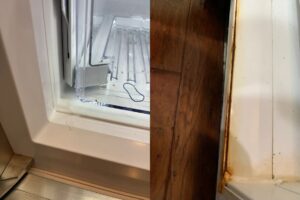
There are no puddles or pools in sight. But you notice damp spots in your drywall, bubbling paint, soft spots in your flooring or a musty smell around the fridge.
These issues indicate a hidden water leak that’s been going on for quite some time. Fix these immediately to avoid structural damage and mold growth in your home.
Hidden In-Wall Plumbing Leak
A plumbing leak in your wall isn’t an appliance issue at all- it requires a licensed plumber with damage-free water leak detection equipment to find the break without demolition.
“We use acoustic leak locators and thermal imaging to find hidden leaks in walls,” Steven explains. “Acoustic detectors are precise down to 0.004 inches and we don’t have to cut your wall open.”
A slow leak inside your wall can go unnoticed for weeks. When you notice a faint musty smell or a damp patch, it’s been there for awhile.
Subfloor Damage From Long-Term Leaking
A hidden leak soaks into the subfloor and causes warping, soft spots, or mold. If your kitchen floor flexes, bends under your feet or looks discolored near the fridge, the leak’s been active much longer than you know.
Call a licensed plumber to fix the source leak first- then, have the subfloor inspected.
Visit Mother’s blog to learn whether to call a plumber or an appliance repair service to fix your leaky refrigerator line.
A Note About Water Pressure and Refrigerator Plumbing
If your refrigerator’s incoming water pressure is too high or too low, your chances of a leak or improper unit performance increase.
The ideal water pressure for most fridges is between 40-60 PSI. “Anything higher or lower than that is a plumbing issue,” Steven notes.
When the Pressure’s Too High
Metropolitan homeowners like those in DFW face high incoming water pressure as the city struggles to meet residential demand.
This pressurized water supply can burst aging water lines and crack the inlet valve behind your fridge.
Low Water Pressure Is Also a Problem
Many units require the incoming water supply to meet a minimum water pressure. Most modern units with water filters require at least 40 PSI to operate properly.
Some customers split a water line between their fridge and dishwasher during installation. This is a common cause of underperformance and low water pressure- especially in ice makers.
If the water pressure’s too low, the seals and springs in your inlet valve don’t close forcefully enough. This creates a dribbling effect that leads to freezer leaks and puddles.
Licensed Professional Refrigerator Leak Repair in Texas
Most homeowners don’t notice the signs of a refrigerator water leak until a few days after it started. Hiring a certified refrigerator repair specialist is vital- we’ll address the leak promptly, proficiently, and with manufacturer-approved techniques that keep your warranty valid.
Contact C&W Appliance Services today for trusted refrigerator repair in Dallas, Fort Worth, Austin, and San Antonio. We expertly fix leaks in every brand, and we’re the only certified Sub-Zero team in the region.
📞 Call Us: 855-358-1496
🌐 Visit Us: https://cwservicesinc.com/